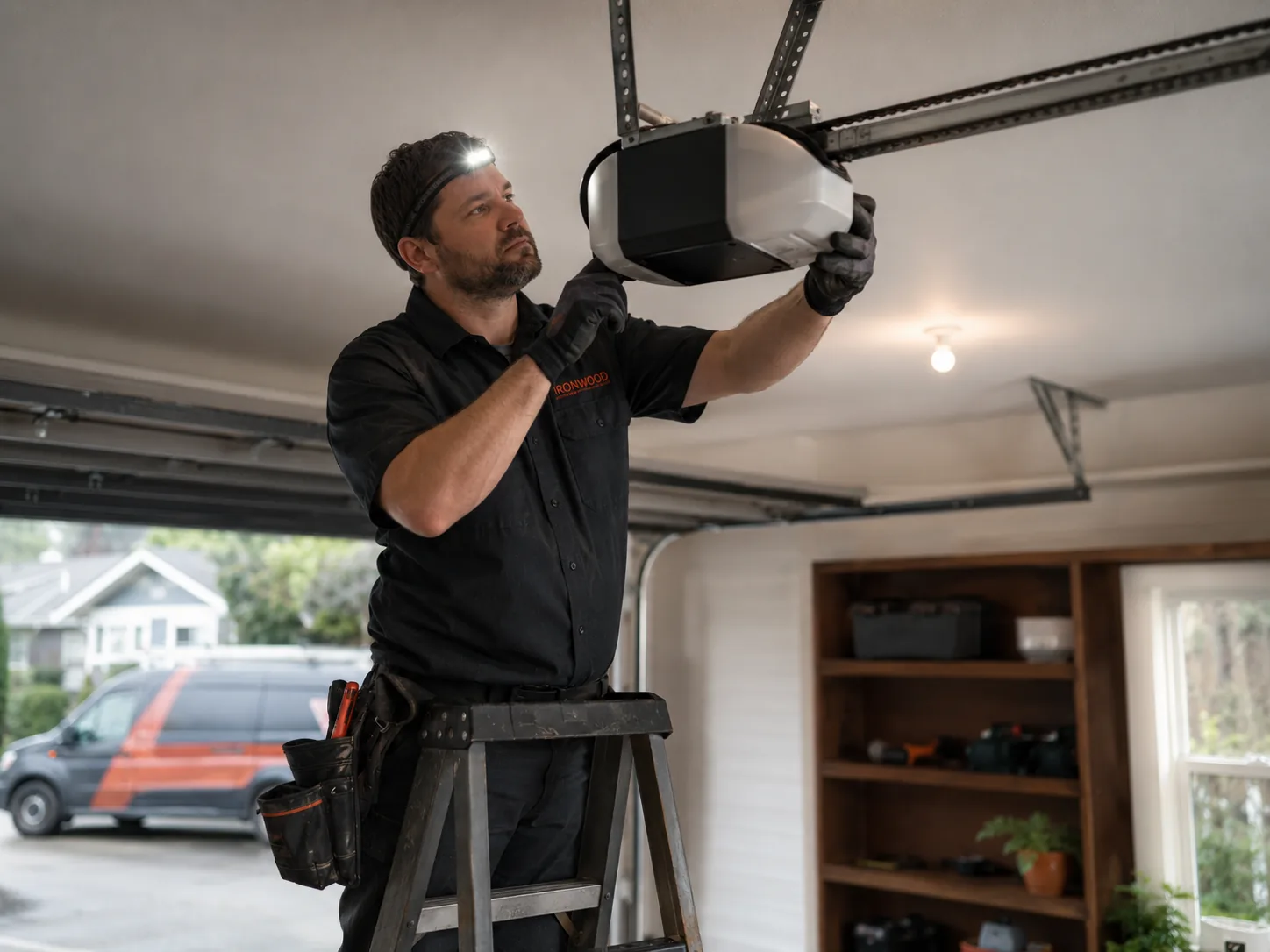
What actually breaks on a garage door opener
The opener is the motor unit bolted to your garage ceiling. It pulls the door up and lets it down along a rail, and it takes signals from your wall button, remotes, and keypad. Most service calls we run in Portland come down to a handful of failures, and knowing which one you have tells you a lot about the fix.
A dead motor is the clearest case. You press the button, nothing hums, and the light may not even come on. Sometimes the motor is genuinely burned out after years of daily cycles. Other times the capacitor that gives the motor its starting kick has failed, which is a cheaper part to replace than the whole unit.
Worn or stripped gears are common on older chain-drive openers. You hear the motor running, but the door does not move, or it moves in fits. The main drive gear inside these units is often plastic and wears down over time. A gear kit replacement brings the opener back without a full swap.
A failing logic board shows up as strange behavior: the door opens on its own, buttons stop responding, the lights flash in patterns, or the unit ignores every remote at once. Portland's wet winters do not help, since damp air and the occasional power surge both shorten board life. If your opener acts possessed, we can often trace it back to this and to related garage door repair in Portland faults on the same circuit.
Remote, keypad, and photo-eye sensor problems are the failures people notice most, and the good news is they are usually the least expensive. A remote may just need reprogramming or a new battery. The photo-eye sensors, those two small units near the floor on each side of the door, refuse to let the door close if they are misaligned, dirty, or blocked. A blinking sensor light is the opener telling you it will not close for safety reasons.
Chain, belt, and screw drive: which opener you have matters
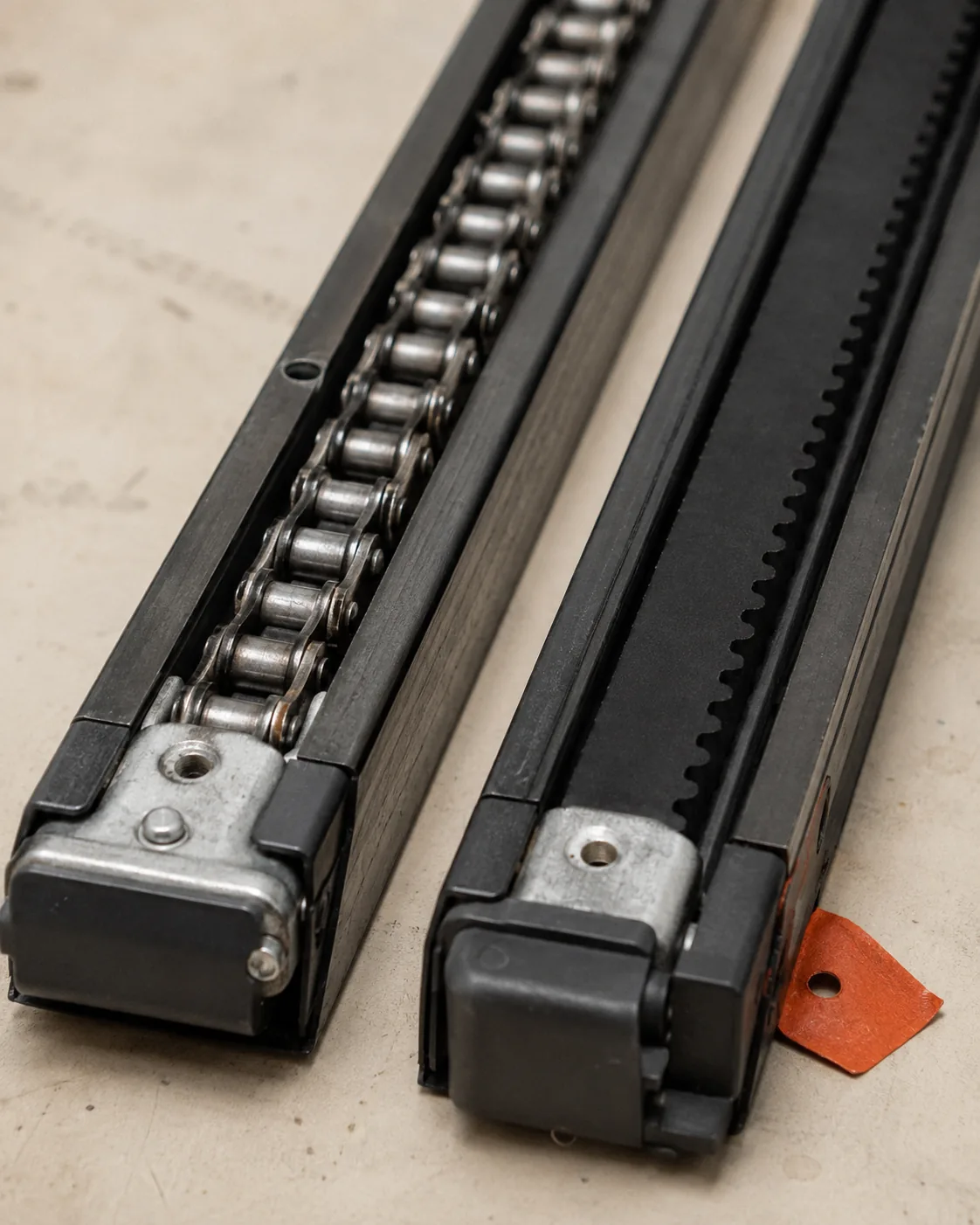
Openers come in three common drive types, and the type affects both the repair and what we would recommend if you replace it.
Chain drive uses a metal chain to pull the trolley along the rail. Durable and inexpensive, but the loudest option — felt most when a bedroom sits over the garage.
Belt drive swaps the chain for a reinforced rubber belt. It runs noticeably quieter with fewer parts to rattle loose. For attached garages in close-built Portland neighborhoods, this is the upgrade most homeowners ask about.
Screw drive uses a threaded steel rod to move the trolley. Few moving parts, but it can get sluggish in cold snaps if the lubricant thickens.
We service all three and stock parts for the brands Portland homes actually run: LiftMaster, Chamberlain, and Genie. If your opener is on its last legs, we can walk you through a straight repair or a garage door opener installation with a quieter belt-drive unit.
Common opener symptoms and what they usually mean
A quick read on what your door is telling you before we arrive.
Door will not close, light blinks
Almost always the photo-eye sensors — misaligned, dirty, or something breaking the beam. Cleaning and realigning fixes most cases without a single part.
Motor hums, door does not move
The motor runs but the drive gear or coupler has stripped, so nothing transfers to the rail. A gear kit or capacitor replacement usually revives the opener.
Remotes stopped working
One dead remote is often a battery or lost code. If every remote fails at once, the logic board or receiver antenna is the more likely cause.
Loud grinding or rattling
Grinding points to worn gears or a dry rail. Rattling can be loose hardware. Both are worth catching early before they turn into a full opener failure.
Door reverses before it closes
The opener's travel or force settings may be off, or the door is binding on worn rollers. We check the door balance along with the opener so the fix holds.
No response at all
Check the wall button and outlet first. If there is power and still nothing, the motor, capacitor, or logic board is the usual suspect and needs a hands-on diagnosis.
Why the opener is only half the story
An opener does not lift the door by brute force alone. The springs above the door carry most of the weight, and the opener just guides the balanced door up and down. When people call about a straining or dying opener, the real problem is sometimes a spring or cable that has failed, forcing the motor to do work it was never built for.
That is why we check the whole system on a service call. If a broken spring is burning out your motor, replacing the opener alone would leave you back here in a few months. We can handle garage door spring replacement cost questions and the fix in the same visit, and if a snapped cable or a door that jumped its track is the culprit, we address the garage door cable repair or the garage door off track at the same time. One trip, one balanced door, an opener that runs the way it should.
How a service call works
You call and describe it
Tell us what the door and opener are doing. That first conversation on (971) 754-2698 usually narrows the cause and tells us which parts to bring.
We diagnose on site
The technician tests the motor, gears, logic board, sensors, and the door's balance. You get a plain explanation of what failed and why, not a guess.
You get options and a price
We tell you whether a repair makes sense or whether replacement is the smarter call, with an up-front estimate before any work starts.
We complete and test it
Most opener repairs are done in one visit. We cycle the door several times and confirm the sensors, remotes, and safety reverse all work before we leave.
Repair or replace: how to decide
A good rule is the opener's age and what is broken. If the unit is under roughly ten years old and the failure is a sensor, a capacitor, a gear kit, or a logic board, repair is almost always the better value. These are defined parts with a clear fix.
Replacement starts to make sense when the motor itself is burned out on a unit that is fifteen or more years old, when parts for that model are no longer made, or when the opener still uses old technology with no rolling-code security and no photo-eye sensors. Modern openers add quieter belt drives, battery backup that keeps the door working during Portland's winter outages, and smartphone control. We give you the honest read either way. If a repair will get you several more good years, we say so.
Portland garage door opener questions
How much does garage door opener repair cost in Portland?
How long does an opener repair take?
Do you repair LiftMaster, Chamberlain, and Genie openers?
My door will not close and the opener light is blinking. What is wrong?
Why does my opener strain or struggle to lift the door?
Do you install new openers, or only repair them?
"Our opener started reversing every time it hit the floor and the light kept flashing. I figured the whole thing was shot. The tech had it sorted in under an hour, just the sensors and a quick alignment, and showed me how to keep them clean. Straight answer, fair price."
"Motor was humming but the door would not budge. Turned out to be a stripped gear on a fifteen-year-old LiftMaster. They gave me the repair-versus-replace math without any pressure, I chose a new belt drive, and the garage is finally quiet enough that it does not wake the baby."
Opener acting up, or dead for days? Ironwood serves the Portland metro and can usually get a technician out fast. Call for a diagnosis and a clear estimate.
Call (971) 754-2698Serving the Portland–Vancouver metro
Ironwood is a mobile garage door service across the Portland–Vancouver metro — there is no storefront to visit, our trucks come to you. Call and we will confirm we reach your street.
(971) 754-2698